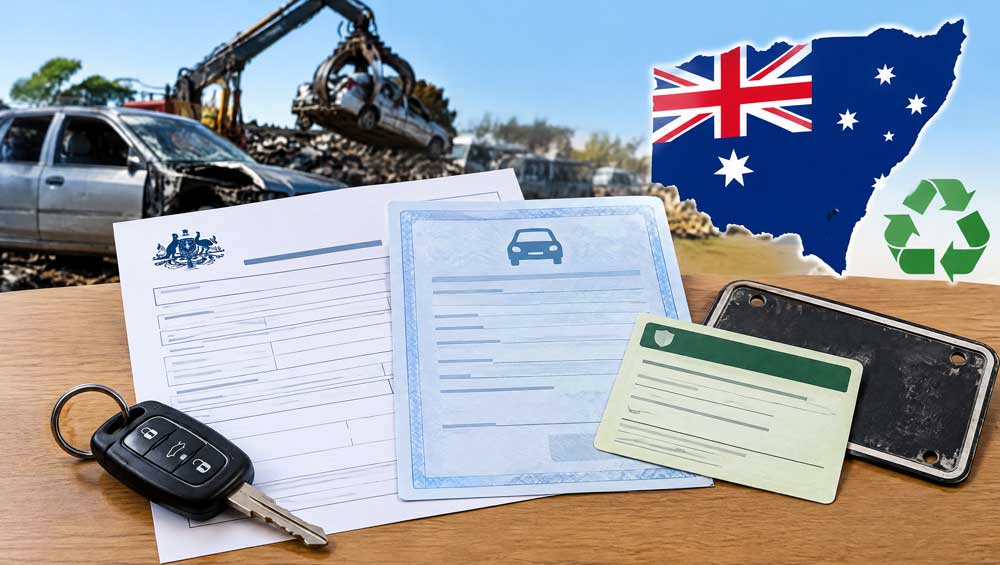
To scrap a car in NSW, prepare photo ID, clear vehicle identification details, evidence that you have authority to dispose of the vehicle, and a written proof of sale. The post-sale step depends heavily on the number plates: a sale to a wrecker with plates generally requires a Notice of Disposal; a sale to a wrecker without plates requires registration cancellation instead.
Introduction
Scrapping a car in NSW is usually more straightforward than a private sale, but the paperwork still matters. The aim is to establish four things clearly: who is disposing of the vehicle, which vehicle it is, whether the seller has authority to sell it, and what happened to the registration after handover.
The important distinction is that not every document plays the same role. A registration certificate can help identify the registered operator and vehicle, but NSW registration is not proof of legal ownership. A service logbook can support vehicle history, but it does not establish title. A receipt records the transaction, while a Notice of Disposal or registration cancellation deals with the vehicle’s registration status after the sale.
For a sale to a motor vehicle recycler or car wrecker, the number plates are especially important. Service NSW currently states that a Notice of Disposal is needed only when the vehicle is sold to a wrecker with number plates. If the car is sold to a wrecker without plates, registration cancellation applies instead. Written-off vehicles after an accident or major damage also follow the cancellation route. Because government processes can change, check the current Service NSW requirements before completing the handover. This guide is general information, not legal advice.
Paperwork You May Need to Scrap a Car in NSW
Use this as a preparation checklist rather than treating every item as a universal legal requirement. The exact documents depend on registration status, finance, ownership or authority issues, and whether the plates remain with the vehicle.
| Document / information | Purpose | Status | Practical note |
| Photo identification | Identify the seller | Core preparation | NSW Driver License or NSW Photo Card is commonly used. |
| VIN and vehicle details | Identify the exact vehicle | Core preparation | Especially important for unregistered or damaged vehicles. |
| Registration details | Identify a registered vehicle | Situational | Useful for registered vehicles; not proof of ownership. |
| Evidence of authority to sell | Show you can dispose of the vehicle | Core in practice | What is suitable depends on the circumstances. |
| Proof of sale / receipt | Record the transaction | Essential record | Both parties should keep a copy. |
| Number plate status | Determine post-sale action | Critical for wrecker sale | Plates on vs plates off changes NOD/cancellation. |
| Finance / PPSR information | Resolve security interests | If relevant | Contact the lender for payout/discharge. |
| Logbook / service history | Support vehicle history | Optional | Does not prove ownership or authority to sell. |
What Proof of Identity Do You Need?
Service NSW lists photo identification among the documents to gather before selling a NSW-registered vehicle. In a straightforward transaction, a NSW Driver Licence or NSW Photo Card is the usual form of identification. A legitimate wrecker may use those details to verify the seller and maintain a clear transaction record.
NSW Driver Licence or Photo Card
Photo ID establishes who is presenting the vehicle for sale. It is also relevant if a Notice of Disposal is lodged online, because Service NSW requires the current registered operator’s NSW Driver Licence or Photo Card details for the online process.
Identification does not prove that you own the car. It should be read together with the vehicle details and whatever evidence supports your authority to sell. Keep a copy of the proof of sale and the Service NSW lodgement or cancellation record so the handover can be traced later if needed.
How Do You Prove You Are Allowed to Scrap the Car?
This is the part most easily confused with registration. The recycler needs a reasonable basis to deal with the person presenting the vehicle, but the evidence can differ depending on how the vehicle came into that person’s possession or management.
Registered Operator Is Not Always the Owner
NSW Government guidance is explicit: the person or organisation named on the Certificate of Registration is the registered operator and is responsible for the vehicle, but the registered operator is not necessarily the owner. The NSW vehicle register itself does not provide evidence of title.
That means registration is useful evidence about responsibility for a registered vehicle, but it should not be described as a universal ownership certificate. Proof of purchase, a bill of sale, signed transfer documents or other supporting records may be relevant where ownership or authority is not obvious.
When the Seller Is Not the Registered Operator
Special situations need stronger documentation. Examples include a company vehicle, a deceased estate, a family member arranging disposal, a carer or guardian, or an authorised representative acting for another person or organisation.
The right evidence depends on the situation. It may include written authority, company documentation, estate documents or other records linking the person arranging the sale to the registered operator or owner. Service NSW has separate processes for several of these circumstances, so confirm the current requirements before arranging collection.
What Vehicle Details Should You Prepare?
The wrecker should be able to identify the exact vehicle from the transaction record. Record the details from the vehicle and current registration information rather than relying on memory.
VIN
The Vehicle Identification Number is the key permanent identifier for most modern vehicles. It is particularly important when a vehicle is unregistered, has no plates, or is too damaged for the plate details to be relied on. Record the VIN on the proof of sale and provide it when requesting a quote if asked.
Registration Number
If the car is currently registered, note the NSW registration number and whether the registration is current, expired or already cancelled. The plate status also affects whether you lodge a Notice of Disposal or cancel registration when selling to a wrecker.
Engine Number
Service NSW recommends including the engine number on the proof of sale. It gives the transaction record another vehicle identifier and can be useful when the car is damaged or unregistered.
Make, Model, Year and Colour
Record the make, model and colour, and keep the build year or model year available where known. These details help the buyer identify the vehicle and reduce errors when the VIN or registration record is checked.
Do You Need the Registration Certificate to Scrap a Car?
Service NSW lists a copy of the Certificate of Registration among the documents to gather before selling a NSW-registered vehicle. If the paper certificate has been lost, stolen or destroyed, a replacement process is available. NSW also provides Digital Vehicle Registration for eligible vehicles.
The key point is what the certificate does and does not prove. It identifies the registered operator and vehicle registration details; it is not proof of legal ownership. A missing paper certificate therefore should not automatically be treated as proof that a person cannot dispose of a vehicle, but the seller still needs clear vehicle identification and appropriate evidence of authority to sell.
If you use a paper Certificate of Registration and complete the Part A Notice of Disposal section, keep a copy. If you use Digital Vehicle Registration, the digital certificate does not have forms on the back, so the disposal process is handled through Service NSW instead.
Do You Need a Receipt or Proof of Sale?
Yes. A written proof of sale is one of the most useful records in the entire transaction. Service NSW advises the seller to provide a bill of sale, receipt or invoice and to keep a copy. It records what vehicle changed hands, when it happened and who the parties were.
What Should Be Included on the Receipt?
A strong proof of sale should include enough detail to identify the vehicle and transaction without relying on a later conversation. Service NSW recommends recording the vehicle details, date and time, and the names, addresses and signatures of both buyer and seller.
- Date and time of handover.
- Plate number where applicable.
- VIN or chassis number.
- Engine number.
- Vehicle colour, make and model.
- Agreed sale amount.
- Buyer name, address and signature.
- Seller name, address and signature.
- Business or dealer details where relevant.
Both parties should keep a copy. A payment record should be kept with it so the paperwork shows not only that the vehicle was handed over but also how the transaction was settled.
Do You Need a Notice of Disposal When Scrapping a Car?
Sometimes – but not in every wrecker sale. This is the most important registration distinction in the article, because Service NSW gives specific instructions for written-off vehicles and sales to a wrecker.
Selling to a Wrecker With Number Plates
Service NSW states that you need to submit a Notice of Disposal only if you sell the vehicle with number plates to a wrecker. In that situation, the sale price entered for the disposal is the amount received for the vehicle parts.
A Notice of Disposal tells Transport for NSW that you are no longer the registered operator and identifies the buyer. Service NSW advises submitting it immediately after the sale and keeping the receipt or a copy for your records.
Selling to a Wrecker Without Number Plates
If you sell the vehicle to a wrecker without number plates, Service NSW says you do not submit a Notice of Disposal. Instead, you must cancel the vehicle registration. If there is unused registration remaining, you may be eligible to apply for a refund.
What Happens If the Car Has Been Written Off?
Service NSW also states that a vehicle written off after an accident or major damage follows the registration-cancellation route rather than a Notice of Disposal. The exact circumstances can matter, so confirm the current Service NSW process if the vehicle has a written-off status or an insurance settlement is involved.
What Should You Do With the Number Plates?
Decide what is happening to the plates before the vehicle is collected, because the answer affects the post-sale registration step. If you remove number plates from the vehicle, Service NSW states that they must be returned to a Service NSW Centre.
Personalised or special plates have additional options. You may be able to replace them with general plates and keep the special plates, exchange them onto another vehicle registered in your name, or include them in the sale subject to applicable transfer fees, ongoing fees and conditions.
For a straightforward wrecker sale, confirm whether the car is being handed over with plates attached or without plates, then complete the matching Service NSW action rather than assuming every scrapped vehicle uses a Notice of Disposal.
What Paperwork Is Needed for an Unregistered Car?
An unregistered car can still be sold to a wrecker. What changes is the registration-transfer side of the transaction: there is no current registration for a buyer to transfer in the ordinary way.
For an unregistered vehicle, prepare photo identification, the VIN and other available identifiers, evidence supporting your authority to sell the vehicle, and a signed proof of sale. If plates are still attached from an expired or cancelled registration, confirm what needs to happen to them and whether any registration cancellation action remains outstanding.
Because an unregistered car may no longer have a useful live registration record, accurate vehicle identification becomes even more important. A wrecker should be able to match the vehicle being collected to the VIN and transaction paperwork.
Can You Scrap a Car Without a Logbook?
Yes. A service logbook is a maintenance record, not proof of ownership or authority to sell. Its absence does not by itself prevent a vehicle from being sold to a wrecker.
A logbook can still be useful because it may show servicing and vehicle history, but that matters more to a buyer assessing a roadworthy used car than to a recycler valuing a damaged, unwanted or non-running vehicle. If you have it, include it with the vehicle. If you do not, focus on identification, authority to sell, proof of sale and the correct registration step.
Can You Scrap a Car Without Registration Papers?
Potentially, yes, depending on the vehicle’s registration status and your circumstances. The Certificate of Registration is useful, but it is not proof of legal ownership. If the vehicle is registered and the paper certificate is missing, Service NSW provides a replacement process, while eligible vehicles may also use Digital Vehicle Registration.
Where registration paperwork is unavailable, make the other evidence stronger: record the VIN and engine number, keep photo identification, retain proof of purchase or other evidence of authority where relevant, and make sure the proof of sale is complete. If ownership or seller authority is disputed or unusual, resolve that before collection.
What If the Car Still Has Finance Owing?
Outstanding finance should be dealt with before the transaction is finalised. Service NSW advises sellers to make sure their financial obligations are met before selling a vehicle. A sale does not automatically erase a security interest registered against the car.
Check the PPSR
A PPSR vehicle search can show whether a security interest is registered against the VIN. It may also return vehicle information sourced through NEVDIS, such as written-off or stolen status. The PPSR does not tell you the amount of finance owing and it does not tell you who legally owns the vehicle.
A PPSR result is therefore a risk check, not an ownership certificate. If a registered security interest appears, the secured party details can be used to clarify the interest.
Contact Your Lender Before the Sale
Ask the lender for a current payout figure and its discharge process. Follow the lender’s settlement instructions, disclose outstanding finance to the buyer, and keep written evidence of payout and discharge. Do not assume an informal agreement with a buyer will automatically remove the security interest from the PPSR.
What If the VIN Is Missing or Damaged?
Treat a missing, defaced or altered vehicle identifier as a serious issue. NSW law places a specific restriction on motor vehicle recyclers: a recycler must not buy a vehicle if its unique identifier has been removed, obliterated, defaced or altered, unless the recycler has written authorisation from a police officer.
That is narrower and more precise than saying every scratched or hard-to-read VIN automatically makes a vehicle illegal to sell. If the identifier is genuinely altered, removed or otherwise falls within the statutory rule, do not try to improvise a sale. Clarify the issue with the recycler and, where appropriate, NSW Police or the relevant authority before collection.
Can a NSW Wrecker Pay You in Physical Cash?
A licensed motor vehicle recycler in NSW cannot buy a motor vehicle, motor vehicle part or accessory using physical cash, a cheque payable to cash, or payment in kind with goods or services. Section 99A of the Motor Dealers and Repairers Act 2013 introduced the cashless-transaction requirement from 1 September 2025.
The law does not require this article to prescribe one specific alternative method. Ask the recycler which permitted non-cash payment method it uses, confirm when payment will be made, and keep the transaction record. This is especially important in an industry where the phrase cash for cars is often used as a marketing term even though physical cash payment to a motor vehicle recycler is prohibited under the current NSW rule.
Step-by-Step NSW Scrap Car Paperwork Checklist
- Confirm you have authority to sell the vehicle. Do not rely on registration alone if ownership or authority is unclear.
- Gather photo identification. Keep your NSW Driver Licence or Photo Card available where applicable.
- Record the vehicle identifiers. Write down the VIN, engine number, make, model, colour and registration details where available.
- Check the registration and plate status. Decide whether the vehicle is being handed over with plates or without plates.
- Resolve outstanding finance if applicable. Contact the lender for payout and discharge instructions.
- Agree the transaction terms. Confirm the amount, collection arrangements, towing or removal charges if any, and the payment method.
- Complete a proof of sale. Record the date and time, vehicle details, amount and both parties’ details and signatures.
- Hand over the vehicle. Remove personal belongings, toll tags, passes and anything you intend to keep.
- Complete the correct NSW post-sale action. Lodge a Notice of Disposal for a wrecker sale with plates, or cancel registration where the wrecker sale is without plates or the vehicle falls into the written-off cancellation situation.
- Return removed plates to a Service NSW Centre.
- Keep your records. Retain the proof of sale, payment record, NOD receipt or cancellation confirmation, and any finance discharge paperwork.
Common Paperwork Mistakes to Avoid
- Assuming the Certificate of Registration proves ownership. It identifies the registered operator, which is not necessarily the owner.
- Treating every document as mandatory. Service history, manuals and spare keys can be useful without being proof of authority to sell.
- Failing to record the VIN. This weakens the transaction record, especially for an unregistered or damaged vehicle.
- Forgetting a written proof of sale. A verbal handover leaves both sides with poor evidence of what happened and when.
- Using the wrong Service NSW disposal step. A wrecker sale with plates and a wrecker sale without plates are treated differently.
- Ignoring number plates. Removed plates must be returned to a Service NSW Centre.
- Leaving finance unresolved. A registered security interest can remain relevant after the vehicle changes hands.
- Accepting a prohibited recycler payment method. Physical cash, cash cheques and payment in kind are prohibited for motor vehicle recyclers under the current NSW rule.
- Trying to sell a vehicle with an altered or removed unique identifier without resolving the issue first.
FAQs
Conclusion – Prepare the Right Paperwork Before the Wrecker Arrives
The paperwork to scrap a car in NSW is easiest when you separate identification, authority, transaction records and registration steps. Prepare photo ID, record the VIN and vehicle details, keep evidence that supports your authority to sell, and complete a signed proof of sale.
Then match the post-sale action to the vehicle. For a wrecker sale with number plates, Service NSW says to lodge a Notice of Disposal. For a sale to a wrecker without plates, or a vehicle written off after an accident or major damage, registration cancellation applies. Return any removed plates and keep the disposal and payment records.
For a straightforward scrap-car collection in Sydney, contact Sydney Car Wrecker to confirm the vehicle details and paperwork before pickup.
| Sydney Car Wrecker Phone: 0451 222 223 Email: info@sydneycarwrecker.com.au Address: 3 Warrior Place, St Marys NSW 2760 Website: www.sydneycarwrecker.com.au |